

Wiring an Off-grid Solar System
Of the many elements involved in putting together an off-grid solar system, wiring is the one that gives most people pause. Also, like other elements of an off-grid system, if you break it down into bite size pieces, it’s a logical and straightforward process that you should be able to tackle easily.
This page will provide a high level overview of wiring an off-grid solar system. The intent is to provide enough of an idea of how the wiring works that you’re not put off by the work involved.
There’s nothing here a competent DIYer cannot handle and nothing that should stop your journey to energy independence.
Remember, this is a high level overview. Each off-grid solar system will be wired slightly differently.
Each DIY solar system kit comes with its own wiring instructions. This is just a guide.
If you need expert assistance, our team is always on hand to help with any DIY solar power system we sell.
General wiring guidance
Most DIY solar panel kits come with the correct wiring for the voltage and amperage. If you’re building your own system, make sure to always use the correct type of wiring for the use.
Keep wires as short and as straight as possible. Shorter wires offer less resistance and will lose less energy during transport. It also helps build a tidy system and one that should be easy to troubleshoot if you need to.
Consider using bus bars instead of wiring to connect batteries. Most battery manufacturers provide them. They are tidy, look nicer and offer a more secure connection than wire.

Want Help Installing an Off-grid Solar Power System?
We offer a nationwide off-grid installation service. Discuss your off-grid power requirements with Sunstore today!
Request a QuoteOff-grid solar panel wiring
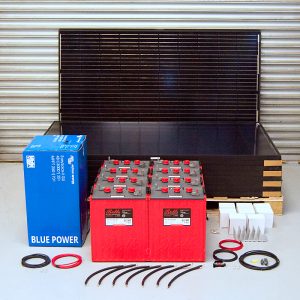
An off-grid solar system kit is just a box of components until you put it all together. It doesn’t become a system until the solar panels and batteries are connected to the charge controller and the controller connected to the property.
Only then does this box of parts become a complete off-grid solar system.
You have three options when connecting solar panels. You can wire them in series, in parallel or a mixture of the two. As this is one of the most important wiring decisions you’ll need to make, let’s tackle that first.
Series wiring
When you wire a solar panel in series, you connect the positive terminal of one panel to the negative terminal in another along the chain. The first positive and last negative of the series connects to the charge controller.
If you wire solar panels in series, you’ll need to add their voltages together. The amperage remains the same though.
For example, if you had 3x panels at 40v each it would carry 3x40v= 120v. The 5 amps of each panel remains at 5 amps.
The advantage of series wiring solar panels is that it can deliver sufficient voltage to make an inverter work efficiently. You can also use smaller wires to connect the panels to the charge controller as voltage travels better over distance.
The disadvantages of series wiring are in troubleshooting. Consider Christmas lights as an example. Years ago, when they were wired in series, you had to remove each bulb in a process of elimination to find the faulty one. It would be the same here. Any issue with wiring or connectivity would mean testing the entire array.
You would also need a Maximum Power Point Tracking (MPPT) charge controller for series wiring. They do offer efficiency advantages but they do come with a cost penalty.
Parallel wiring
Wiring solar panels in parallel means connecting both positive and negative terminals to each other. Positive to positive, negative to negative. The first and last connections connect to the solar system.
If you wire solar panels in parallel, you’ll need to add their amperages together instead of voltage.
In the same example as above, the 3x 40v panels will remain at 40v but the 3x 5amps means a requirement of 15 amps.
The advantage of parallel wiring is that you can produce a lot of energy without exceeding the voltage limit of the solar power inverter. That is, as long as you don’t exceed the amperage limitation.
It’s also easier to troubleshoot issues and you will continue generating energy even if one of your panels is down.
The disadvantage of parallel wiring is that it requires slightly thicker cables to carry the amperage without losing energy during transport.
You would typically use a Pulse Width Modulation (PWM) charge controller with parallel wiring, which is less efficient than MPPT but much cheaper.
Mixed wiring
Mixed wiring combines series and parallel wiring into one system. The idea is to not exceed the voltage limitation with the series array and not exceed the amperage limitation with the parallel array.
For example, you could wire two panels up in series to hit the voltage limit of your charge controller. You could then wire another pair as parallel to keep voltage low but meet the amperage limitation.
Our Most Popular Off-grid Solar Kits for Homes

Price range: £3,456.99 through £4,290.95 including v.a.t.
This product has multiple variants. The options may be chosen on the product page
Price range: £6,502.26 through £9,982.26 including v.a.t.
This product has multiple variants. The options may be chosen on the product page

Price range: £7,301.92 through £10,781.92 including v.a.t.
This product has multiple variants. The options may be chosen on the product page
Wiring off-grid solar system batteries
Next up is the batteries. These will also connect to your charge controller to be supplied with energy from the panels.
Energy will flow from the panel to the charge controller. It will then feed from the charge controller to the batteries. Like panels, batteries can be connected in series, parallel or a mixture of the two.
Ideally, you should use the same type, age and capacity batteries in your solar system to help keep the system balanced.
Series wiring
Like with your solar panels, connecting batteries in series adds the voltages together but not the amperage. That means a set of four 12v 200Ah batteries could deliver 48v at 200Ah per hour.
As with solar panels, voltage travels better than amperage, so if you have a longer cable run, it’s better to transport voltage than amperage.
Parallel wiring
Parallel wiring adds the amperage together but not the voltage. That means a set of four 12v 200Ah batteries could deliver 800Ah when fully charged. That could be 800Ah per hour, 400Ah for two hours, 200Ah for four hours and so on.
Amperage gives you more battery capacity but you may lose more energy during transport. As you lose amperage during transport, you have to factor that into your calculations.
Mixed wiring
Mixed wiring offers the same advantages as it does with solar panels. You combine battery capacity with increased voltage.
In all cases, battery wiring should be kept as short as possible to avoid resistance within the wires. You could wire batteries together or use bus bars, depending on the situation.
Connect the charging source to the positive and negative terminals of the first and last batteries in the bank to keep the entire bank balanced.
Wiring the off-grid solar system to the property
Once you wire your solar panels and your batteries to the charge controller, you should now connect the controller to the property.
What happens next depends on the system you’re building. If you’re feeding a property, you’ll need to connect an inverter between the charge controller and the property to convert DC current to AC.
If you’re feeding a boat, vehicle or just need DC, you can connect the charge controller directly to the grid.
Large capacity systems will also need fuses and breakers to maintain the safety of the system. Exactly where and how you install these will depend on the system you’re installing.
Specific instructions will be included within each DIY solar system kit.
As a general rule, using breakers and fuses makes your off-grid solar system safer. However, using the right breaker and the right fuse in the right place can make all the difference.
Again, specific instructions and the correct fuses and/or breaker will be included in your off-grid solar system kit.
If you need help, advice or would prefer to have your off-grid solar system installed by experts, contact Sunstore at [email protected] or call us on 01903 213141.
Request a Quote
Fill in the form below for a free no-obligation quote. Our off-grid installation service is available nationwide and starts from £360.
Please note, this is for OFF-GRID enquiries only. Off-grid systems differ to grid connected systems in cost and design. If you have a grid connection please click here for our On-grid installation service.
[logo-carousel id=brands-solar]
